
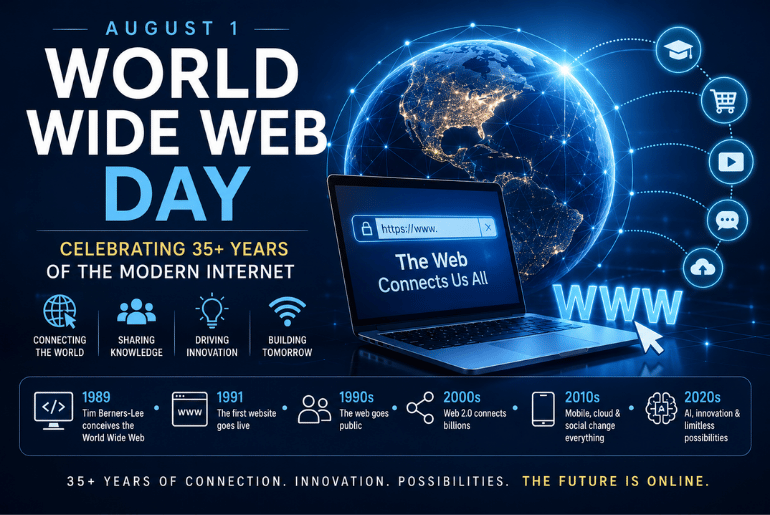
Every year on August 1, World Wide Web Day recognizes one of the most transformative inventions in modern history. More than 35 years after the World Wide Web was introduced to the public, the technology continues to shape how people communicate, learn, shop, work, and access information across the globe.
While the internet itself was developed through decades of research, the creation of the World Wide Web made online information accessible to everyday users, laying the foundation for the digital world that billions rely on today.
The Birth of the Modern Web
The World Wide Web was invented by British computer scientist Tim Berners Lee in 1989 while working at CERN, the European Organization for Nuclear Research. His goal was to create a system that allowed researchers to easily share information through linked digital documents.
The first website became publicly available in the early 1990s, introducing concepts that remain essential today, including web pages, hyperlinks, and web browsers.
Those innovations transformed the internet from a network used primarily by researchers into a platform that could be accessed by homes, schools, businesses, and governments around the world.
How the Web Changed Everyday Life
Over the past three decades, the World Wide Web has reshaped nearly every aspect of daily life.
Consumers now use websites and online platforms to shop, stream entertainment, book travel, manage finances, attend virtual classes, and connect with friends and family.
Businesses have embraced digital commerce, allowing companies of every size to reach customers far beyond their local communities. News organizations publish breaking stories in real time, while creators, entrepreneurs, and educators build careers through websites and online platforms.
The web has also changed how people search for information, replacing printed directories and reference books with instant access to billions of pages.
Artificial Intelligence Is Shaping the Web’s Next Chapter
As World Wide Web Day is observed in 2026, artificial intelligence is becoming one of the biggest forces driving the internet’s continued evolution.
AI powered search tools, virtual assistants, personalized recommendations, and automated content creation are changing how users discover information and interact with online services.
Technology companies are investing heavily in AI features that promise faster search results, smarter productivity tools, and more personalized online experiences, signaling another major shift in the way people use the web.
Cybersecurity and Privacy Remain Major Priorities
As online activity continues to grow, protecting personal information has become increasingly important.
Cybersecurity experts encourage internet users to create strong passwords, enable multi factor authentication, recognize phishing scams, and regularly update software to reduce security risks.
Privacy has also become a central issue as consumers seek greater transparency about how companies collect, store, and use personal data.
These ongoing challenges continue to influence technology policy, product development, and public awareness campaigns across the United States.
A Technology That Continues to Evolve
The World Wide Web has come a long way since its earliest days, when simple text based websites represented the cutting edge of digital communication.
Today, the web powers streaming platforms, online banking, cloud computing, telehealth services, remote work, social media, and artificial intelligence applications that reach billions of people every day.
As innovation continues at a rapid pace, the World Wide Web remains one of the most influential technologies ever created, serving as the foundation for the connected world and opening the door to the next generation of digital experiences.