
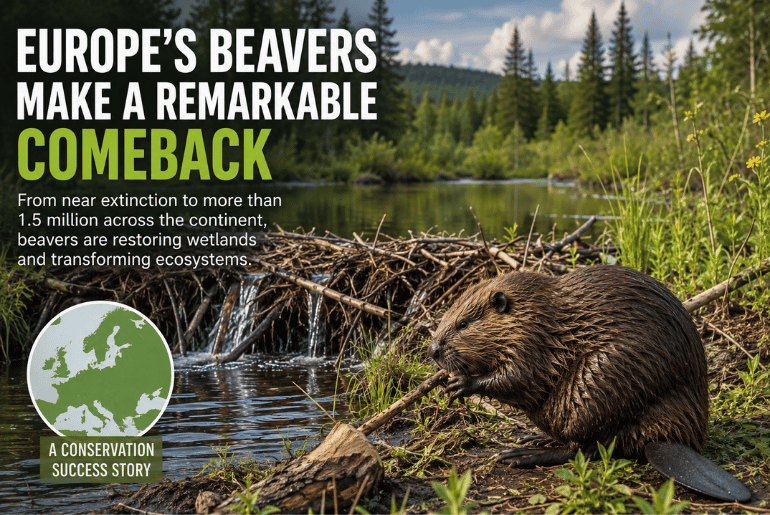
The Eurasian beaver has gone from the brink of extinction to one of Europe’s biggest conservation success stories, offering a rare piece of positive environmental news. After decades of coordinated restoration efforts, the species now numbers more than 1.5 million across the continent, according to conservation estimates.
Once nearly wiped out by hunting and habitat destruction, the native beaver has reclaimed rivers, streams, and wetlands in dozens of countries. Wildlife experts say the recovery demonstrates how long term conservation policies can help restore species that were once considered unlikely to survive.
A Species Nearly Lost Forever
By the early 1900s, the Eurasian beaver had almost disappeared from Europe. Centuries of hunting for its valuable fur, meat, and castoreum, a natural substance historically used in perfumes and traditional medicine, had devastated the population.
At the same time, wetlands were drained and rivers were altered to support agriculture and development, leaving beavers with fewer places to live and reproduce.
Historical records estimate that only about 1,000 to 1,200 Eurasian beavers remained in a handful of isolated populations across the continent.
Conservation Efforts Changed the Outlook
The recovery began after governments and conservation organizations introduced stronger protections for the species.
Beavers were given legal protection from hunting in many countries, while restoration projects focused on rebuilding wetlands and improving river habitats. Carefully planned reintroduction programs also returned beavers to areas where they had vanished generations earlier.
Over time, those efforts allowed populations to grow naturally. Today, the Eurasian beaver occupies large sections of Europe, with more than 1.5 million animals estimated to live throughout the region.
Conservationists now describe the recovery as one of the most successful wildlife restoration efforts in modern history.
Why Beavers Are So Important
Beavers are widely known as ecosystem engineers because they naturally reshape the environment in ways that benefit many other species.
By building dams, they create wetlands that provide habitat for fish, amphibians, birds, insects, and aquatic plants. These wetlands also help improve water quality by trapping sediment and pollutants before they move downstream.
In addition, beaver ponds slow the flow of water during heavy rainfall, helping reduce flood risks while storing water that can support ecosystems during dry periods.
Scientists say these natural processes have become increasingly valuable as communities look for ways to strengthen landscapes against changing weather patterns.
A New Challenge in Finland
Although the Eurasian beaver has made a remarkable recovery, conservationists continue to address challenges involving a separate population of North American beavers.
Around 80 American beavers were introduced into Finland during the 1930s. Their descendants now number an estimated 10,000 to 15,000 animals.
Because the introduced species competes with the native Eurasian beaver for habitat and food, wildlife managers are working to reduce the nonnative population while protecting Europe’s indigenous beaver.
The effort aims to preserve the long term health of the native species without reversing decades of conservation progress.
A Rare Bright Spot for Wildlife
Environmental news often focuses on declining biodiversity and habitat loss. The story of the Eurasian beaver offers a different perspective by showing that conservation investments can produce meaningful results when sustained over many decades.
From a population of little more than one thousand animals at the beginning of the 20th century to more than 1.5 million today, the Eurasian beaver has become a symbol of successful wildlife restoration.
Its comeback also highlights the importance of protecting natural habitats, restoring damaged ecosystems, and maintaining conservation programs that allow native species to recover for future generations.