
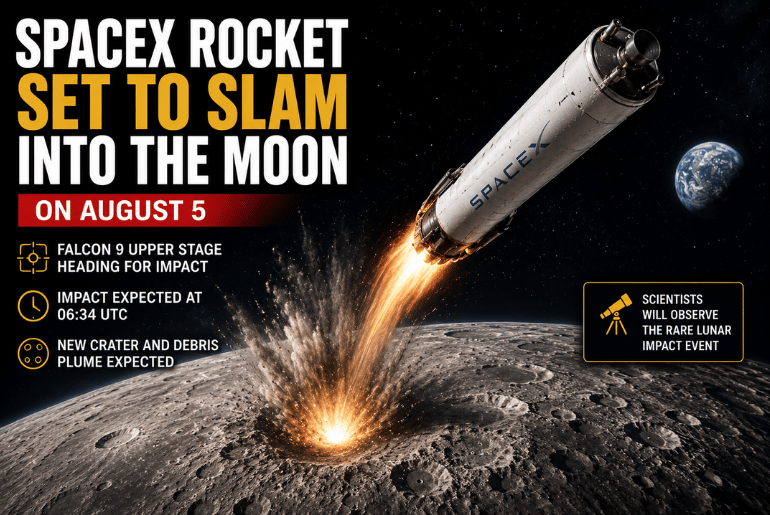
A spent SpaceX Falcon 9 rocket stage is on course to hit the Moon next week in an unusual celestial event that has scientists and skywatchers paying close attention.
The uncrewed upper stage is expected to strike the lunar surface on August 5, 2026, near the Moon’s Einstein Crater. Researchers say the impact could create a fresh crater and produce a debris plume that may be observed by telescopes.
When Will the SpaceX Rocket Hit the Moon?
Current projections put the impact at about 06:34 UTC on August 5, although the exact timing can shift slightly as scientists continue refining the object’s trajectory.
The rocket stage is expected to hit the Moon at roughly 5,400 miles per hour. Researchers estimate the spacecraft hardware weighs around 3,900 kilograms, or more than 8,500 pounds.
The collision is expected near the Moon’s western limb, close to Einstein Crater.
Why Is a SpaceX Rocket Headed for the Moon?
The rocket stage was part of a January 2025 SpaceX Falcon 9 launch that carried lunar landers toward the Moon. Firefly Aerospace’s Blue Ghost lander successfully reached the lunar surface, while Japan’s Hakuto-R Mission 2 later failed during its attempted landing.
After completing its primary role, the Falcon 9 upper stage remained in space without enough fuel to place itself on a different long term trajectory. Its orbit has gradually carried it toward the Moon.
The Impact Could Create a New Lunar Crater
Scientists expect the collision to excavate a crater several dozen feet across.
Recent modeling estimates suggest the crater could be roughly 66 to 98 feet wide, although the final size will depend on the exact impact conditions. The collision could also launch lunar dust and debris high above the surface.
Researchers are particularly interested in the debris plume because it could reveal how the Moon’s surface reacts when struck by a known object traveling at a known speed.
Could People See the Crash From Earth?
That remains uncertain.
Scientists believe the impact could generate a brief flash and a plume of ejecta, but the event is not expected to be visible to the naked eye. Specialized telescopes may have a better chance of detecting the impact and its aftermath.
The Moon’s position and lighting conditions at the time of impact will also affect how easily the event can be observed from Earth.
NASA and Scientists Will Be Watching
NASA’s Lunar Reconnaissance Orbiter is expected to play a role in monitoring the area around the impact site. Orbital observations before and after the collision could help scientists identify the resulting crater and examine changes to the lunar surface.
A recent scientific study also modeled the expected ejecta plume and found that the central portion could rise as high as 75 to 100 kilometers, or roughly 47 to 62 miles, above the Moon’s surface.
A Rare Opportunity for Lunar Science
Although the collision is accidental, researchers see scientific value in it.
Unlike a natural asteroid impact, scientists know the approximate size, mass, speed and trajectory of the Falcon 9 stage. That makes the event an unusual real world test of models used to study lunar impacts and debris behavior.
The results could help researchers better understand how artificial objects affect the lunar environment as more spacecraft begin heading toward the Moon.
Space Junk Is Becoming a Lunar Issue
The upcoming collision also highlights a growing challenge for the expanding lunar economy.
As NASA, SpaceX and other companies send more spacecraft toward the Moon, leftover hardware and other objects will increasingly become part of the cislunar environment. Scientists say the Falcon 9 impact is a reminder that future missions will need better strategies for managing spacecraft after their primary missions are complete.
What to Expect on August 5
The upcoming impact is not expected to pose any danger to people on Earth. Instead, scientists will be watching for a brief flash, a rising dust plume and the creation of a new crater on the lunar surface.
For space fans, August 5 could offer a rare chance to watch a man made object leave a visible mark on the Moon, even if the event can only be captured through powerful scientific instruments.
The SpaceX rocket’s impact is currently expected near Einstein Crater at about 06:34 UTC on August 5, making the event one of the more unusual space stories to watch as the summer continues.