
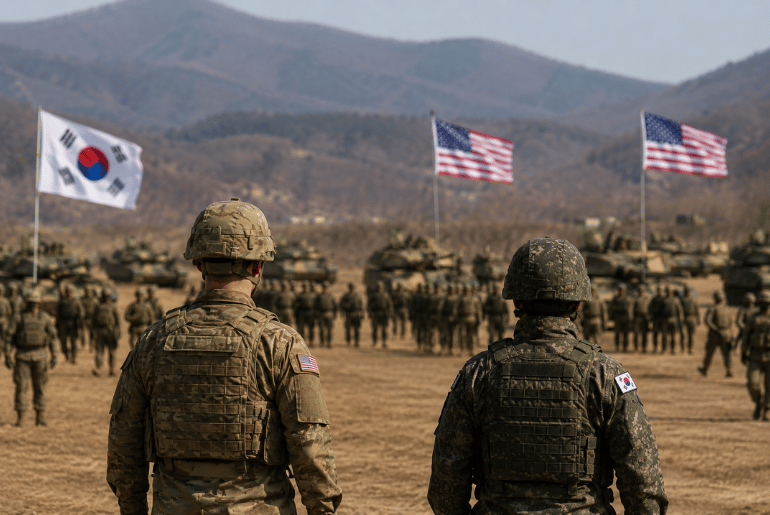
President Donald Trump has instructed the Pentagon to substantially reduce future joint military exercises between the United States and South Korea, putting a major U.S. security partnership under fresh scrutiny.
Trump said the exercises send a signal that is inappropriate and hostile toward North Korea. He also pointed to his relationship with North Korean leader Kim Jong Un and South Korea’s decision not to support U.S. efforts related to Iran.
The announcement came as the annual Ulchi Freedom Shield exercise was getting underway on Aug. 17.
Ulchi Freedom Shield Begins as Planned
The current exercise has not been canceled.
Ulchi Freedom Shield is scheduled to run from Aug. 17 through Aug. 27 and involves about 18,000 South Korean troops, along with U.S. and allied personnel. The drills are designed to strengthen the allies’ ability to respond to threats on the Korean Peninsula.
Training includes scenarios involving drones, cyberattacks and GPS disruptions, reflecting the changing nature of modern warfare.
Trump said it was too late to cancel the current exercise but directed Defense Secretary Pete Hegseth to substantially reduce joint exercises going forward.
Trump Points to Relationship With Kim Jong Un
Trump’s comments put his relationship with Kim at the center of the decision.
The president has previously expressed interest in restarting diplomacy with North Korea and has emphasized his personal relationship with Kim. His latest comments again suggest that maintaining an opening for negotiations with Pyongyang remains a priority.
Trump described North Korea as having been unthreatening and respectful during his presidency, a characterization that contrasts sharply with the U.S. and South Korean military’s longstanding assessment of the threat posed by North Korea’s nuclear and missile programs.
South Korea Faces a New Test in the Alliance
The announcement comes at a sensitive moment for Washington and Seoul.
South Korea remains a major U.S. ally in East Asia, with American forces stationed on the peninsula as part of the countries’ longstanding security arrangement.
South Korean officials have expressed interest in maintaining strong coordination with Washington while also hoping that Trump’s approach could help reopen dialogue with North Korea.
The decision could therefore create a balancing act for Seoul as it seeks to preserve its military readiness while supporting diplomatic efforts to reduce tensions.
North Korea Has Condemned the Exercises
North Korea has long criticized U.S. and South Korean military exercises, describing them as preparations for an invasion.
Before this year’s drills began, North Korean officials called the exercises increasingly provocative and warned that Pyongyang would strengthen its nuclear deterrent. North Korea has also conducted recent ballistic missile launches, adding to tensions surrounding the military exercise.
Washington and Seoul maintain that the exercises are defensive and are intended to improve their ability to respond to a potential attack.
Readiness Concerns Remain
Any significant reduction in joint exercises could affect how frequently American and South Korean forces train together.
Military exercises allow troops from both countries to practice communications, command procedures and responses to complex battlefield scenarios. Critics of Trump’s decision have warned that scaling back the drills could create readiness concerns and weaken the visible U.S. commitment to South Korea.
Supporters of Trump’s approach could argue that reducing exercises may lower costs and create additional room for diplomacy with North Korea.
A Significant Shift in U.S. Policy
The announcement represents another significant development in Trump’s approach to America’s military commitments overseas.
Trump has previously criticized the cost and scale of U.S. military exercises with South Korea. He suspended major exercises following his first summit with Kim Jong Un in 2018, although large scale joint training later resumed after diplomatic efforts stalled.
The latest directive brings those earlier concerns back into the spotlight while the administration weighs its broader strategy toward the Korean Peninsula.
What Happens Next
For now, Ulchi Freedom Shield is continuing as scheduled through Aug. 27.
The bigger question is what future U.S. and South Korean exercises will look like after Trump’s directive to the Pentagon. The administration has not publicly detailed how much the scale of future drills will change.
South Korea is meanwhile signaling that it wants to preserve the strength of the U.S. alliance while pursuing opportunities for dialogue with North Korea.
The decision leaves Washington, Seoul and Pyongyang watching closely as the United States weighs military readiness against Trump’s push for a different approach to North Korea.