
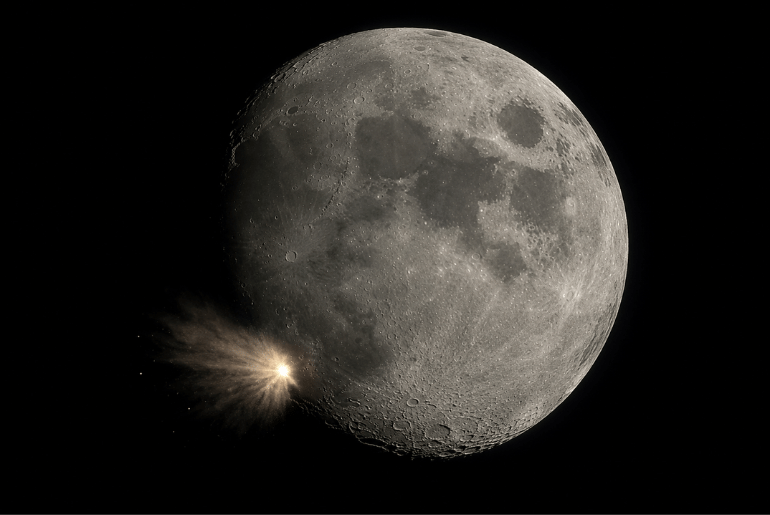
A spent SpaceX Falcon 9 rocket stage has slammed into the Moon after spending more than a year drifting through space, creating a rare human-made lunar impact that scientists are now watching closely.
The roughly 4-ton upper stage struck the Moon on Wednesday, August 5, near the Einstein and Bell craters. The collision happened at an estimated speed of about 5,400 mph. Scientists had predicted the impact and tracked the rocket stage as it approached the lunar surface.
The impact was not intentional, and it posed no danger to Earth. NASA had been monitoring the rocket stage and preparing telescopes and spacecraft to study what happened when it reached the Moon.
A Falcon 9 Stage Takes an Unusual Final Trip
The rocket stage began its journey on January 15, 2025, when SpaceX launched a Falcon 9 carrying two commercial lunar landers toward the Moon.
The mission successfully sent Firefly Aerospace’s Blue Ghost lander and ispace’s Resilience lander toward their destinations. Blue Ghost later made a successful lunar landing, while Resilience did not complete its planned landing.
After completing its part of the mission, the Falcon 9 upper stage remained in space instead of returning to Earth.
Over time, solar activity and gravitational forces altered its trajectory and eventually put it on a collision course with the Moon. NASA said its Center for Near Earth Object Studies later confirmed that the stage had a 100% chance of impacting the lunar surface.
The Impact Happened Near Einstein Crater
Scientists had predicted that the rocket stage would hit near the Einstein and Bell crater region along the Moon’s western limb.
The location made direct observation from Earth difficult. The impact occurred in an area close to the boundary between the Moon’s near side and far side, limiting the chances of seeing the event with ground-based telescopes.
Astronomers attempted to observe the impact, but the expected flash and debris plume were difficult to detect from Earth.
The exact impact site will require additional observations from lunar spacecraft.
NASA Expects a New Lunar Crater
NASA estimates that the collision could have created a crater roughly 60 feet wide and 12 feet deep.
Because the Moon has virtually no atmosphere, there was nothing to slow the rocket stage before it reached the surface. The collision therefore sent lunar dust and rock outward from the impact area.
The impact is tiny compared with the massive craters created by asteroids over billions of years, but scientists say the event still provides a valuable opportunity to study how artificial objects behave when they hit the Moon.
Scientists Want to Study the Debris
The impact gives researchers a chance to study the behavior of lunar material after a high-speed collision.
NASA said observations of the ejecta plume can help scientists better understand the Moon’s geology and improve computer models used for future lunar missions.
The event is particularly useful because researchers knew the size, origin and approximate trajectory of the object before it reached the Moon.
That makes the collision different from most natural lunar impacts, where scientists do not know the incoming object’s exact characteristics ahead of time.
Lunar Spacecraft Will Search for the Impact Site
NASA’s Lunar Reconnaissance Orbiter is expected to look for the new crater after the collision.
The space agency is also working with other spacecraft and observation teams to gather information about the site. NASA said the South Korean Korea Pathfinder Lunar Orbiter and its ShadowCam instrument could also help examine the area.
Scientists may have to wait several days before suitable spacecraft positions and lighting conditions allow the impact area to be photographed.
The Moon Is Becoming a Busier Place
The accidental crash comes as the United States and other countries prepare for a major increase in lunar activity.
NASA’s Artemis program envisions additional robotic missions followed by human exploration, while commercial companies are developing spacecraft designed to deliver equipment and eventually support astronauts on the lunar surface.
That means the amount of hardware operating around the Moon is expected to increase substantially in the coming years.
The Falcon 9 incident is therefore drawing attention not only because of the unusual crash itself, but also because it highlights the importance of tracking and managing objects around the Moon.
This Was Not a Deliberate SpaceX Crash
NASA emphasized that the Falcon 9 stage’s collision with the Moon was unplanned.
SpaceX has been working with NASA to monitor the stage and its trajectory. The company said the unexpected lunar impact resulted from the effects of solar activity and gravity after the rocket completed its original mission.
NASA also noted that controlled disposal of rocket stages on the Moon can be a technically accepted option in certain circumstances. The difference in this case is that the stage’s lunar impact was not intentionally planned as its end-of-life destination.
A Rare Human-Made Mark on the Moon
The Falcon 9 impact is another reminder that human activity is beginning to leave more noticeable traces beyond Earth.
The Moon has been hit by countless natural objects throughout its history, but deliberate lunar exploration has added a growing number of spacecraft, landers and other hardware to its surface and surrounding environment.
As lunar missions accelerate, scientists and space agencies will have to keep track of where hardware goes after its primary mission ends.
For now, researchers are focused on finding the crater created by the Falcon 9 stage and studying what the unusual collision can reveal about the Moon.
What Happens Next
The most important next step is confirmation through lunar imagery.
NASA expects its Lunar Reconnaissance Orbiter and other spacecraft to examine the predicted impact area and look for the fresh crater. Those observations could provide the clearest evidence of the collision and help researchers measure its effects.
The Falcon 9 stage’s journey began with a successful commercial lunar mission in January 2025 and ended more than a year later with an unexpected impact on the Moon.
For scientists, however, the crash marks the beginning of another mission of sorts: turning an accidental lunar collision into an opportunity to learn more about the Moon and prepare for a busier future in space.