
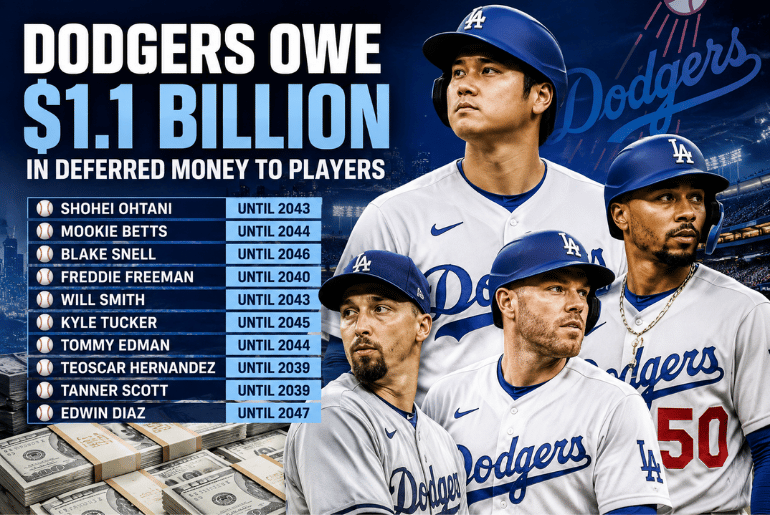
The Los Angeles Dodgers are once again at the center of the baseball world, but this time the conversation is focused on the club’s long term financial commitments rather than its star powered lineup. A viral social media post highlighting more than $1.1 billion in deferred salary obligations has sparked widespread discussion about how the franchise structures contracts and manages its payroll.
While the eye popping figure has surprised many fans, baseball executives and financial analysts point out that deferred compensation has become a strategic tool under Major League Baseball’s financial system. For the Dodgers, it has helped create one of the most talented rosters in the sport while spreading salary payments over future decades.
What Deferred Salary Means
Deferred salary allows a player to receive a portion of his earnings after the playing contract has ended. Instead of paying the full value during the active years of a deal, the club schedules part of the compensation to be paid over many additional years.
This approach provides payroll flexibility while still allowing players to secure guaranteed income well into retirement. Deferred compensation has existed in baseball for decades, but the Dodgers have taken the strategy to a level that continues to draw national attention.
Shohei Ohtani Headlines the Long Term Commitments
Much of the discussion centers on Shohei Ohtani, whose groundbreaking contract became one of the most creative financial agreements in professional sports history.
Most of Ohtani’s salary will be paid after his playing contract concludes, with payments continuing through 2043. The structure helped reduce the club’s competitive balance tax payroll during the life of the agreement while guaranteeing the superstar a massive long term payout.
Ohtani’s deal quickly became the blueprint that fueled conversations about deferred compensation across Major League Baseball.
Several Dodgers Stars Have Deferred Contracts
Ohtani is far from the only player with future payments scheduled well beyond his playing years.
The Dodgers reportedly have deferred salary commitments extending for several key players, including Mookie Betts, Freddie Freeman, Blake Snell, Will Smith, Kyle Tucker, Tommy Edman, Teoscar Hernández, Tanner Scott, and Edwin Díaz.
Some of those payments are expected to continue into the mid 2040s, illustrating just how aggressively the organization has embraced deferred compensation.
Why the $1.1 Billion Figure Needs Context
Although the total commitment exceeds $1.1 billion, that number does not represent money the Dodgers owe immediately.
Instead, the payments are spread across many years under contracts negotiated with each player. Because the money is paid over an extended period, its present value is significantly different from the combined future payment total.
Financial experts note that deferred contracts are legal under MLB rules and are commonly used throughout professional sports, even if few organizations have accumulated commitments on this scale.
Baseball Fans Continue to Debate the Strategy
The Dodgers’ financial approach has become one of the hottest topics among baseball fans and analysts.
Supporters argue that the front office has simply taken advantage of rules available to every franchise. By spreading payments into future years, the club has remained aggressive in free agency while consistently fielding a championship caliber roster.
Critics believe the growing use of deferred contracts creates an uneven competitive landscape, allowing wealthier organizations to stockpile elite talent more easily than smaller market clubs.
The debate is expected to continue as more teams evaluate similar contract structures.
What It Means for the Dodgers’ Future
Despite the massive long term commitments, the Dodgers remain positioned as one of baseball’s premier contenders. Their willingness to invest in superstar talent reflects confidence in the franchise’s long term revenue and financial stability.
Whether other organizations adopt similar strategies remains to be seen, but the Dodgers have undoubtedly changed how many people view modern baseball contracts.
A Financial Model That Continues to Shape MLB
The Dodgers’ reported $1.1 billion in deferred salary commitments has become one of the biggest financial stories in baseball. While the headline grabbing figure has fueled debate, it also highlights the evolving business side of Major League Baseball.
As long as elite free agents continue signing contracts with deferred compensation, the Dodgers are likely to remain at the forefront of conversations about roster building, payroll management, and the future economics of America’s pastime.