
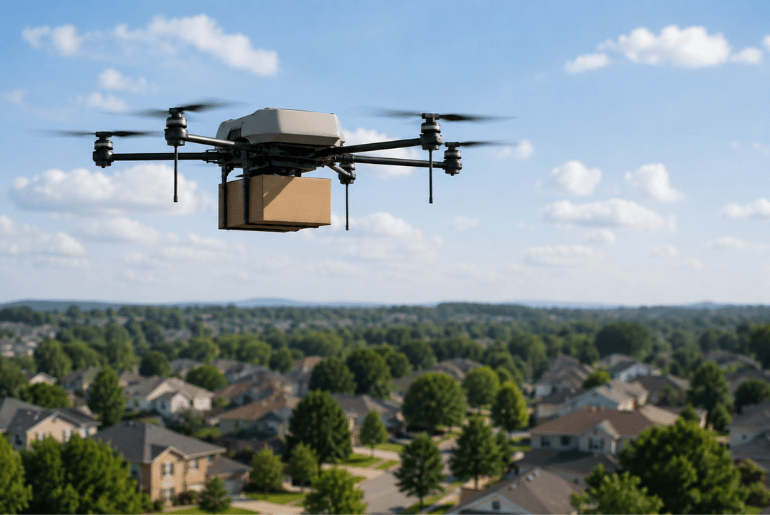
Amazon is preparing for one of the biggest expansions yet of its Prime Air drone delivery service, with plans to bring the technology to nearly 500 cities and towns across the United States by the end of 2026.
The expansion would increase Prime Air’s current footprint roughly sixfold and could make airborne package delivery available to communities with tens of millions of customers. Amazon says eligible items could arrive in as fast as 30 minutes, pushing the company further into a future where a last minute shopping run might be replaced by a package arriving from the sky.
For Americans who have spent years hearing that drone delivery was just around the corner, the latest announcement suggests the idea may finally be moving beyond a handful of test markets.
Amazon Plans a Major Prime Air Expansion
Amazon announced on August 19 that Prime Air is expected to reach nearly 500 U.S. cities and towns before the end of the year.
The company says the expansion is designed to bring drone delivery to communities across the country and significantly increase the number of customers who can use the service. New metropolitan areas identified in reports include Chicago, Atlanta, Cleveland, Syracuse and Boise.
Prime Air is part of Amazon’s broader effort to speed up the final step of delivery, often called the last mile. Instead of putting every small package onto a truck or van, certain orders can be loaded onto an autonomous drone and flown directly toward an eligible delivery location.
That could be especially useful for the kind of everyday purchases people do not always want to wait days to receive, such as household essentials, electronics and other smaller items.
How Fast Can Amazon Drone Delivery Be?
Amazon says Prime Air can deliver eligible orders in as fast as 30 minutes in the expanding network. The service currently focuses on smaller and lightweight packages, and Amazon has said its drones can carry packages weighing up to five pounds.
The company has also expanded the types of products available through drone delivery. Amazon previously said its drone network could handle tens of thousands of items, including certain consumer electronics and everyday essentials.
For shoppers, the appeal is simple. Forgetting batteries before a road trip or needing a small household item could eventually mean opening the Amazon app instead of getting back in the car and driving to the store.
Of course, availability will still depend on where customers live, what they are ordering and whether their address meets the requirements for drone delivery.
Where Will Amazon’s Drones Fly?
Amazon has not released a simple city by city consumer list covering all nearly 500 planned locations. However, the expansion includes major metropolitan areas and surrounding communities as Prime Air grows beyond its current footprint.
Federal aviation records also show Amazon’s continued work to expand operations in several parts of the country, including proposed or approved activity connected to areas such as Chicago, Florida, Texas, Kansas City, Detroit and Baton Rouge.
The Federal Aviation Administration has reviewed environmental and operational plans for Prime Air locations, with the MK30 drone expected to play a major role in the expansion. The FAA describes the electric drone as having an operating range of up to 7.5 miles from a delivery center, with a potential service area of about 174 square miles around each site.
That means drone delivery is unlikely to appear everywhere overnight. Instead, Amazon will need a growing network of delivery centers and approved operating areas capable of serving nearby homes and businesses.
What the New MK30 Drone Brings to the Expansion
Amazon has positioned its MK30 drone as a major step toward making large scale delivery more practical.
The company previously described the aircraft as smaller, lighter and quieter than earlier versions. Those improvements matter because drone delivery faces challenges that go beyond simply getting a package from point A to point B.
Drones have to operate safely around homes, trees, power lines and other obstacles while also meeting federal aviation requirements. Noise is another concern for neighborhoods that may eventually see multiple drone flights each day.
Amazon says its newer technology includes systems designed to detect and avoid obstacles, a key part of convincing regulators and communities that delivery drones can operate safely at a larger scale.
Will Drone Delivery Change the Way Americans Shop?
The biggest question may be whether customers actually change their shopping habits once drone delivery becomes widely available.
Two day shipping once felt revolutionary. Then came next day delivery, same day delivery and increasingly faster options. Amazon’s latest move takes that competition into a new category by making 30 minute delivery a potential option for millions more people.
Amazon has already built a massive same day delivery network across the United States, and the company views Prime Air as another piece of its push toward faster fulfillment. Earlier this year, Amazon said Prime Air was operating in several U.S. locations and that its long term goal included serving 30 million customers and eventually delivering hundreds of millions of packages by drone.
For many shoppers, drone delivery may initially be more of a convenience feature than a replacement for traditional deliveries.
A large television, furniture or a week’s worth of groceries will still require conventional transportation. But for smaller purchases, the idea of getting an item delivered before a typical lunch break or during a busy afternoon could become increasingly normal.
Amazon Faces Competition in the Race for the Sky
Amazon is not the only company betting that small drones will become part of everyday American commerce.
Other companies, including Walmart and DoorDash, have also invested in drone delivery as businesses search for faster ways to get smaller orders to customers.
The competition could eventually push retailers to rethink what customers expect from delivery speed.
For years, online shopping has largely been a tradeoff between convenience and waiting. The faster delivery gets, the smaller that tradeoff becomes.
The challenge for Amazon and its competitors will be turning drone delivery from an impressive novelty into a service that is reliable, affordable and useful enough for people to use regularly.
The Future of Amazon Deliveries May Be Closer Than It Looks
Amazon’s plan to reach nearly 500 cities and towns by the end of 2026 would represent a major shift for Prime Air.
The company has been working on drone delivery for more than a decade, and the technology has taken longer to reach the mainstream than early predictions suggested. But a sixfold expansion in a single year would signal that Amazon believes the service is finally ready for a much larger audience.
For customers, the biggest change may not be the sight of drones overhead.
It may be the moment when getting a small package in 30 minutes feels less like something from a science fiction movie and more like another everyday option on the checkout page.
As Amazon expands Prime Air across the United States, Americans in hundreds of cities and towns could soon find out whether the future of shopping really does arrive at the front door from the sky.