
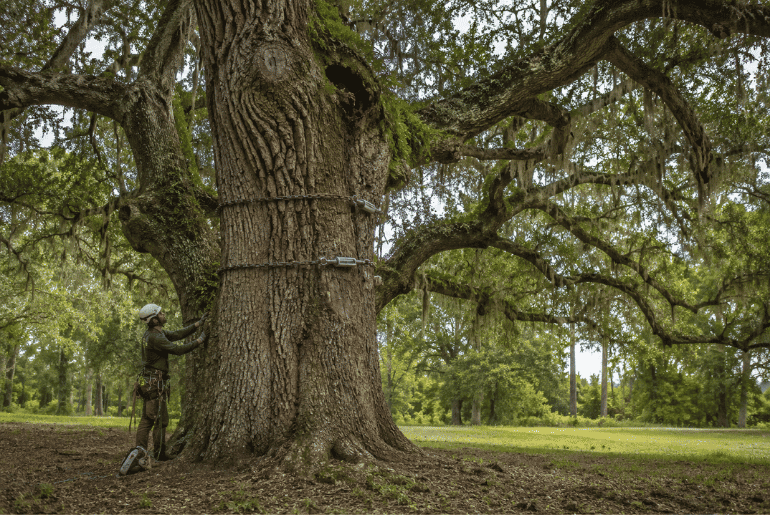
A massive live oak in South Carolina is getting a second chance after standing for roughly three centuries, including through one of the final major battles of the American Revolutionary War.
The historic tree sits at the Eutaw Springs battlefield in Eutawville, where American and British forces fought on Sept. 8, 1781. Preservationists now believe the rare “witness tree” could survive for generations if a major restoration effort succeeds.
A Living Connection to the American Revolution
The Eutaw Springs tree is estimated to be about 300 years old. That means it was already standing decades before the Declaration of Independence was signed in 1776.
When the Battle of Eutaw Springs took place in 1781, the oak was estimated to be around 50 years old. The tree stands on land where British troops had established a camp before the fighting began.
The battle became one of the final major engagements of the Revolutionary War’s Southern Campaign. American forces led by Maj. Gen. Nathanael Greene attacked British troops commanded by Lt. Col. Alexander Stewart.
Although the British held the battlefield, the fighting contributed to the larger pressure that eventually pushed British forces toward Charleston and the end of the war in the South.
Why the Tree Is Called a Witness Tree
A witness tree is simply a living tree that existed during a significant historical event.
That makes the Eutaw Springs oak especially unusual. Very few trees connected to the Revolutionary War are believed to have survived to the present day.
The tree stands about 45 feet tall, with a canopy stretching roughly 130 feet. Its trunk measures about 72 inches in diameter. Spanish moss and resurrection fern add to the distinctly Southern appearance of the old oak.
For historians and preservationists, the tree offers something a textbook cannot.
It is a living piece of the landscape that was there when American and British troops clashed on the same ground.
The Tree’s Biggest Problem Came Decades After the War
The oak survived the Revolutionary War, storms, development and generations of change. But an event more than 50 years ago created one of its biggest challenges.
Lightning struck the tree and split part of its structure. Workers responded by installing heavy iron chains and steel cables to keep the damaged sections together. Those measures helped stabilize the oak at the time.
Now, those same supports have become a threat.
As the tree continued to grow, parts of the metal hardware became embedded in the bark. Preservationists say the chains and cables can restrict the tree and interfere with its ability to move nutrients through the affected areas.
Arborists Are Giving the Oak a Major Makeover
Specialists from SavATree began a detailed restoration project this month with help from the American Battlefield Trust and the South Carolina 250 Commission.
The work includes removing old hardware that has become embedded in the tree, improving the soil around its roots and installing a modern structural support system.
Arborists are also installing a new lightning protection system designed to direct a future lightning strike safely toward the ground instead of allowing the electricity to damage the oak.
The restoration is expected to continue for at least a year before the tree’s condition is reassessed.
A Historic Tree Gets a Modern Support System
The preservation work is not simply about keeping an old tree standing.
Experts want the oak to remain healthy enough to continue growing without the kind of restrictive hardware that helped it decades ago but is now causing problems.
The new support system is designed to provide structural assistance while giving the tree more flexibility. Soil treatments are also intended to improve conditions around the roots and help the tree recover.
The goal is ambitious: preservationists hope the tree can remain standing for another century or longer.
The Timing Is Significant for America’s 250th Anniversary
The restoration comes during America’s 250th anniversary year, giving the project additional historical significance.
South Carolina is using the anniversary to highlight sites connected to the American Revolution, including battlefields and other historic locations throughout the state.
The Eutaw Springs property is also connected to the Liberty Trail, a statewide heritage network designed to connect South Carolina locations tied to the Revolutionary War.
Preserving the oak gives visitors a chance to experience history in a way that feels much more immediate than simply reading about a battle.
The Battlefield Is Becoming a Larger Historic Destination
The tree sits across from Eutaw Springs Battlefield Park on a four acre historic parcel preserved by the American Battlefield Trust and South Carolina Battleground Preservation Trust.
Plans call for the property to become part of a larger historical park expansion connected to the Liberty Trail.
That could give visitors another reason to stop in the Eutawville area and learn about a chapter of American history that does not always receive the same attention as better known Revolutionary War sites.
A Tree That Has Outlasted Generations
The Eutaw Springs oak has already survived for about 300 years.
It was standing before the United States became a country. It remained rooted while armies moved across the surrounding landscape. It survived a devastating lightning strike and continued growing even as the supports installed to save it slowly became part of the problem.
Now preservationists are trying to make sure the tree gets the care it needs for the next chapter of its life.
If the restoration succeeds, future visitors to Eutaw Springs could stand beneath the same enormous branches and look at a living piece of American history that has been rooted there since before the Revolutionary War.