
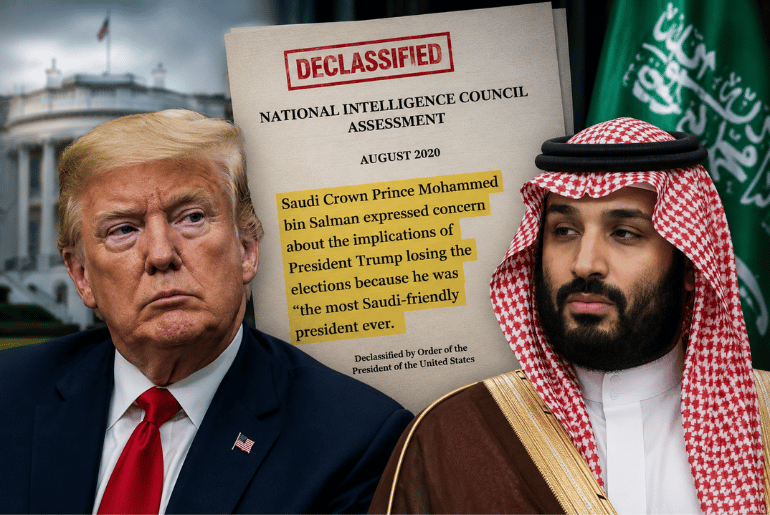
WASHINGTON, D.C. A newly declassified U.S. intelligence assessment indicates that Saudi Crown Prince Mohammed bin Salman privately expressed concern about the possibility of then President Donald Trump losing the 2020 presidential election, according to material released by the White House.
The August 2020 National Intelligence Council assessment stated that the Saudi leader viewed Trump as the most Saudi friendly president in modern American history and was concerned about what a change in administration could mean for the long standing relationship between Washington and Riyadh.
The disclosure surfaced after journalist Barak Ravid highlighted the document on social media, drawing renewed attention to the close relationship between the Trump administration and Saudi Arabia during Trump’s first term in office.
Intelligence Assessment Focused on Foreign Leaders’ Views
The declassified assessment reportedly documented the private views and concerns of foreign leaders as the United States approached the 2020 election.
According to the released material, Mohammed bin Salman believed a Trump defeat could reshape U.S. policy toward Saudi Arabia, particularly on issues involving regional security, arms sales, and diplomatic cooperation in the Middle East.
The assessment did not accuse Saudi Arabia of attempting to influence vote totals or interfere in the election process. Instead, it reflected the preferences and expectations of a key American ally regarding the outcome of a closely watched presidential race.
Trump Administration Maintained Strong Saudi Ties
Relations between Washington and Riyadh strengthened significantly during Trump’s first term.
The administration supported major arms agreements with Saudi Arabia and maintained close communication with Saudi leadership on regional issues, including Iran, energy markets, and counterterrorism efforts.
The relationship also drew criticism from lawmakers in both parties following the 2018 killing of Saudi journalist Jamal Khashoggi, an incident that intensified congressional scrutiny of U.S. policy toward the kingdom.
Despite those concerns, the Trump administration largely preserved its strategic partnership with Saudi Arabia.
Disclosure Revives Debate Over Foreign Preferences
Foreign governments routinely monitor U.S. elections because changes in leadership can affect trade, military cooperation, sanctions policy, and diplomatic priorities.
Current and former intelligence officials have noted that it is common for foreign leaders to favor one candidate over another based on expected policy outcomes.
The newly released assessment provides a rare public glimpse into those private calculations and offers additional context about how America’s allies viewed the stakes of the 2020 election.
Why the Report Matters
The release is likely to attract attention from both foreign policy observers and domestic political analysts because it reinforces perceptions of exceptionally close ties between Trump and Saudi leadership during his presidency.
For supporters of Trump, the disclosure may be viewed as evidence of a strong international partnership with an important Middle Eastern ally.
Critics, meanwhile, are expected to point to the report as another example of the unusually warm relationship between the administration and the Saudi government.
As more declassified intelligence materials become public, officials and analysts will continue examining how America’s allies and rivals viewed one of the most consequential elections in recent U.S. history.