
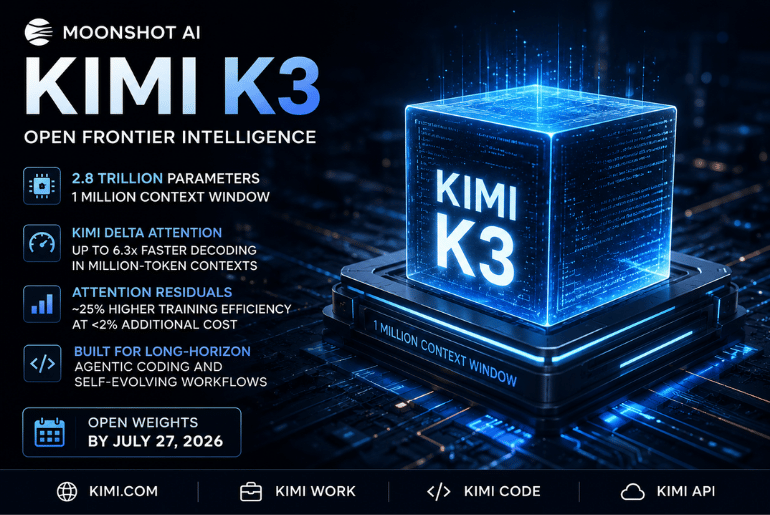
Moonshot AI on Wednesday introduced Kimi K3, a new artificial intelligence model the company says is designed for long-running software tasks, multimodal reasoning and large-scale automation workflows.
The announcement places Kimi K3 among the biggest AI systems publicly disclosed to date, with the company reporting that the model contains 2.8 trillion parameters and supports a context window of up to one million tokens.
The launch comes as competition among major AI developers continues to intensify, with companies racing to build systems capable of handling larger workloads and more sophisticated tasks.
Company Highlights Long-Context Performance
According to Moonshot AI, Kimi K3 was built to process lengthy documents, code repositories and complex research materials without losing context during extended interactions.
The company said its new “Kimi Delta Attention” architecture enables decoding speeds up to 6.3 times faster in million-token environments compared with previous approaches.
Moonshot also introduced a technique called “Attention Residuals,” which it says improves training efficiency by roughly 25% while adding less than 2% to computational costs.
The technical claims have not yet been independently verified by outside researchers.
Focus Shifts Toward AI Agents and Coding Workflows
Rather than positioning Kimi K3 solely as a chatbot, Moonshot is marketing the model as infrastructure for autonomous coding agents and self-improving workflows capable of operating over extended periods.
Industry analysts increasingly view AI agents as one of the next major battlegrounds in the artificial intelligence sector, particularly in software engineering, enterprise automation and research applications.
Developers have shown growing interest in systems that can maintain context across entire codebases, product roadmaps and technical documentation libraries.
Open Weights Could Expand Developer Access
Moonshot announced plans to release Kimi K3’s model weights by July 27, a move that could significantly expand access for developers and researchers.
Open-weight releases allow organizations to run models on their own hardware and customize them for specialized use cases, although they differ from fully open-source projects that include training data and source code.
The strategy contrasts with many frontier AI systems that remain available only through cloud-based services and proprietary APIs.
Kimi Ecosystem Receives Immediate Rollout
The company said Kimi K3 is already available through Kimi.com, Kimi Work, Kimi Code and the Kimi API platform.
The broad rollout suggests Moonshot intends to target both consumer and enterprise users as it expands its presence in the increasingly crowded AI market.
Growing Competition Defines Global AI Race
The launch arrives during a period of rapid advancement across the artificial intelligence industry as major technology firms continue investing billions of dollars into larger and more capable models.
For businesses and developers, the biggest question may not be how large models can become, but whether those systems can deliver measurable improvements in productivity, software development and automation.
Kimi K3 now enters that test as one of the year’s most closely watched AI releases.