
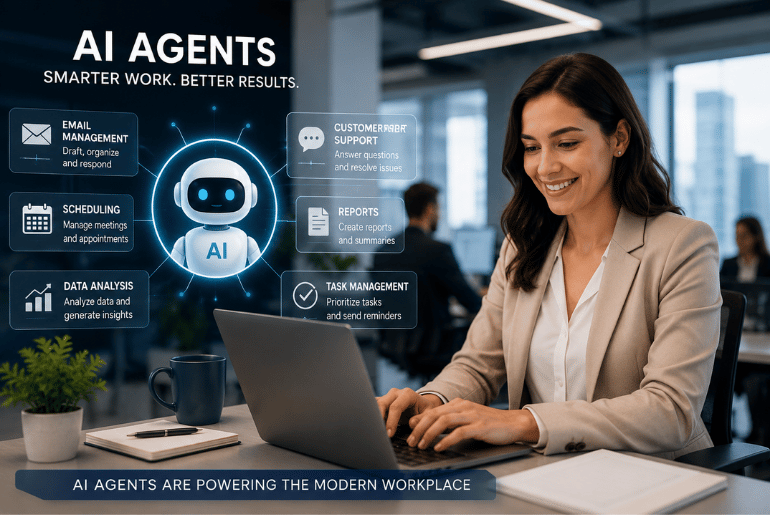
Artificial intelligence has entered a new phase in the United States. After years of attention fueled by futuristic promises and eye catching product launches, AI is quietly becoming part of the average workday. Across industries, businesses are adopting AI agents to complete routine tasks, support employees, and improve productivity without dramatically changing how people work.
Rather than treating artificial intelligence as an experimental technology, companies are beginning to view AI agents as practical digital assistants that help teams save time and focus on higher value work. The shift reflects a growing trend in the American workplace where automation is becoming less about replacing employees and more about making existing teams more efficient.
Businesses Are Choosing Practical Results Over Big Promises
When generative AI first gained widespread attention, many organizations rushed to test chatbots and content generation tools. While those early experiments generated excitement, business leaders soon realized that real value comes from applying AI to everyday operations.
Today, AI agents are being used to organize schedules, summarize meetings, answer customer questions, prepare reports, draft emails, monitor projects, and retrieve information from multiple business systems. These practical applications allow employees to spend less time on repetitive administrative work and more time solving problems, building customer relationships, and making strategic decisions.
Instead of chasing the latest technology trend, companies are focusing on solutions that deliver measurable improvements in efficiency.
What Makes AI Agents Different?
Unlike traditional software that performs one specific task, AI agents can manage a series of connected activities with limited human input.
For example, an AI agent can receive a customer request, search internal documents for relevant information, prepare a response, notify the appropriate department, and create a follow up reminder for the employee responsible for the case.
Many AI agents also connect directly with workplace applications such as email, calendars, customer relationship management platforms, cloud storage services, and project management software. This allows businesses to automate workflows without forcing employees to learn entirely new systems.
Customer Service Is Leading the Way
One of the fastest growing uses of AI agents is customer support.
Businesses are using intelligent assistants to respond to common questions, organize support tickets, recommend solutions, and direct customers to the correct department when human assistance is needed.
Instead of replacing customer service representatives, AI agents help reduce wait times by handling repetitive inquiries. Employees can then dedicate more attention to complex situations that require personal interaction.
This combination of automation and human support is improving response times while maintaining customer satisfaction.
Marketing Teams Are Seeing Faster Workflows
Marketing professionals are also finding practical uses for AI agents.
Many businesses now rely on AI to brainstorm campaign ideas, draft promotional copy, summarize research, organize marketing calendars, and analyze customer engagement data.
While creative decisions remain in the hands of marketing teams, AI helps eliminate time consuming tasks that previously slowed campaign development.
The result is a faster production process without sacrificing human creativity or brand identity.
Small Businesses Are Joining the AI Movement
Artificial intelligence is no longer limited to major technology companies.
Affordable subscription services have made AI tools accessible to small businesses across the country. Independent retailers, local law firms, accounting offices, real estate agencies, and consulting firms are increasingly adopting AI to improve daily operations.
Because many AI platforms require little technical experience, smaller organizations can begin using advanced automation without investing in expensive infrastructure or hiring specialized developers.
This wider availability is allowing businesses of all sizes to compete more effectively in an increasingly digital economy.
Employees Are Learning New Skills
The growing use of AI agents is also changing workplace expectations.
Instead of asking whether employees know how to use spreadsheets or presentation software, some employers are beginning to value experience working with artificial intelligence.
Workers who understand how to communicate effectively with AI systems, review AI generated content for accuracy, and combine automation with human judgment are becoming increasingly valuable across multiple industries.
Technology experts believe these skills will become as common as basic computer literacy over the next several years.
Companies Continue to Prioritize Security
Despite rapid adoption, businesses remain cautious about protecting sensitive information.
Organizations are developing internal policies that define how employees should use AI responsibly, particularly when handling customer records, financial documents, or confidential business information.
Many software providers now offer enterprise versions of AI platforms with enhanced privacy protections, administrative controls, and secure data management features designed specifically for corporate environments.
For many executives, responsible implementation has become just as important as technological capability.
AI Is Supporting Employees Rather Than Replacing Them
Although concerns about job displacement continue to surface, many business leaders say the current focus is on collaboration instead of replacement.
AI agents are proving most effective when they eliminate repetitive work while allowing employees to concentrate on tasks requiring creativity, communication, leadership, and critical thinking.
This partnership between human expertise and artificial intelligence is helping organizations improve productivity without removing the human element from decision making.
Rather than replacing workers, AI is becoming another workplace tool alongside email, spreadsheets, and video conferencing.
The Future of Everyday Work
Technology analysts expect AI agents to become increasingly capable over the next few years. Future systems may coordinate projects, prepare financial summaries, manage inventory, organize meetings, and assist with business planning while remaining under human supervision.
As software companies continue integrating AI into existing business platforms, employees may soon interact with intelligent assistants throughout nearly every part of the workday.
For many American businesses, the conversation has already shifted away from whether AI should be adopted. The focus is now on how organizations can use the technology responsibly to improve efficiency, support employees, and deliver better experiences for customers.
A Quiet Workplace Revolution
Artificial intelligence is no longer defined by flashy demonstrations or ambitious predictions. Across offices throughout the United States, AI agents are quietly handling routine responsibilities that once consumed valuable hours each day.
As businesses continue investing in practical automation, AI is becoming less of a futuristic concept and more of a dependable workplace partner. The companies finding the greatest success are not replacing people with technology. Instead, they are giving employees better tools to accomplish more, making AI one of the most significant productivity shifts in the modern American workplace.