
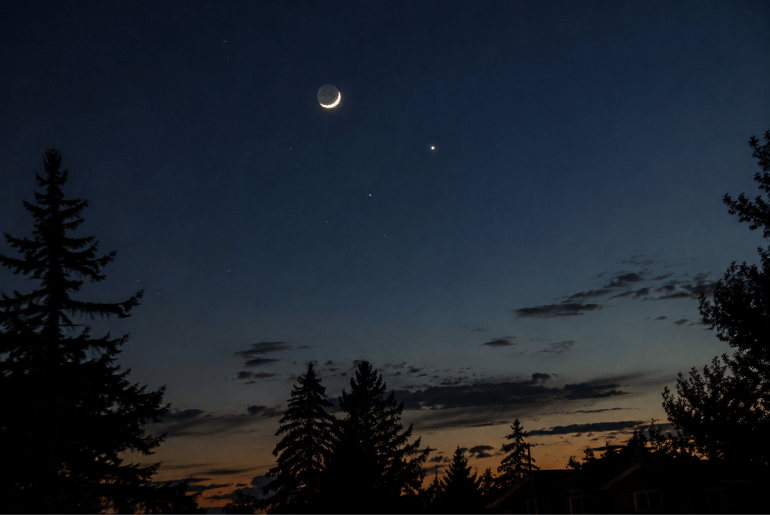
Americans looking for a reason to spend a few minutes outdoors after sunset will have one tonight as the Moon and Saturn appear unusually close together in the evening sky.
The celestial event, known as a conjunction, will be visible across much of the United States on the night of July 7, weather permitting. While the two objects only appear close from Earth’s perspective, the alignment creates a striking view that can be enjoyed without a telescope.
Astronomy enthusiasts say the pairing is one of the easiest skywatching events of the month because the Moon acts as a bright guide, making Saturn much easier to locate.
When to Watch
The best viewing window begins about an hour after local sunset and continues through the late evening. Observers should look toward the eastern sky, where the Moon will appear bright and easy to identify. Saturn will be visible nearby as a steady golden point of light.
Unlike stars, Saturn typically shines with a constant light instead of twinkling. That makes it easier to distinguish once the sky becomes fully dark.
Most people will be able to enjoy the event without special equipment. A pair of binoculars can make Saturn easier to spot, while a small telescope may reveal hints of the planet’s famous ring system.
A Summer Event Anyone Can Enjoy
Unlike meteor showers that require dark skies or eclipses that happen only along narrow paths, tonight’s conjunction is accessible to nearly everyone with a clear view of the sky.
Families, amateur photographers, and backyard stargazers are expected to spend time outdoors enjoying the event. Local astronomy clubs in several communities often organize informal viewing sessions whenever notable celestial events occur.
Experts recommend finding an area away from bright streetlights for the best experience. Parks, nature preserves, and open fields usually provide darker skies that improve visibility.
Why the Moon and Saturn Look So Close
Although they appear side by side, the Moon and Saturn are separated by an enormous distance.
The Moon orbits Earth at an average distance of about 239,000 miles. Saturn, the sixth planet from the Sun, is hundreds of millions of miles away. Their apparent closeness is simply the result of the viewing angle from Earth.
These alignments happen because the Moon moves across the sky each month, occasionally passing near planets from our perspective. Each conjunction creates a different arrangement, giving skywatchers new opportunities throughout the year.
Tips for Better Viewing
Skywatching does not require expensive gear, but a few simple steps can make the experience more enjoyable.
Allow your eyes several minutes to adjust to the darkness before searching for Saturn. Avoid checking a bright phone screen repeatedly, since that can reduce your night vision.
If possible, choose a location with an unobstructed view of the eastern horizon. Clear skies will naturally provide the best viewing conditions, while haze or heavy cloud cover may limit visibility.
Those interested in photographing the event can use a smartphone with a night mode or a camera mounted on a tripod for longer exposures.
A Reminder to Look Up
In a season filled with vacations, outdoor concerts, and baseball games, tonight’s conjunction offers another reason to enjoy a summer evening outside.
Astronomical events like this often serve as an introduction to stargazing for people who rarely spend time observing the night sky. They also remind viewers that impressive natural sights do not always require travel or special planning.
As darkness settles across the United States tonight, millions of Americans will have the opportunity to witness one of the week’s most eye-catching celestial events simply by stepping outside and looking up.